


Story Ideas for a Child Starting School
The worries children have about starting school are rarely the ones adults prepare them for. Twelve story situations aimed at the actual anxieties — lunch, toilets, and not knowing anyone's name.
Key points
-
The worries are logistical, not emotional
"Will I make friends?" is an adult's version of a question children ask much more concretely.
-
Show not-knowing, then finding out
A character who is confident from page one is no use to a child who is not.
-
Two or three weeks ahead, not the night before
A story read on the last evening reads as a warning; the same story read a fortnight earlier reads as information.
-
Let the character get it wrong once
A story where nothing goes wrong quietly promises that nothing will.
What they are actually worried about
Adults prepare children for the emotional shape of school: will you be brave, will you make friends, will you enjoy it.
Ask a four-year-old and you get something much more concrete. Where are the toilets. What happens at lunch. What if I need someone and I can't find you. What do I do if I don't know anybody's name.
These are answerable questions. Answering them is more useful than reassurance about bravery, which addresses a feeling the child has not had yet and may not have.
Twelve situations worth a story
Each of these is one specific unknown, told as something that happens to somebody else.
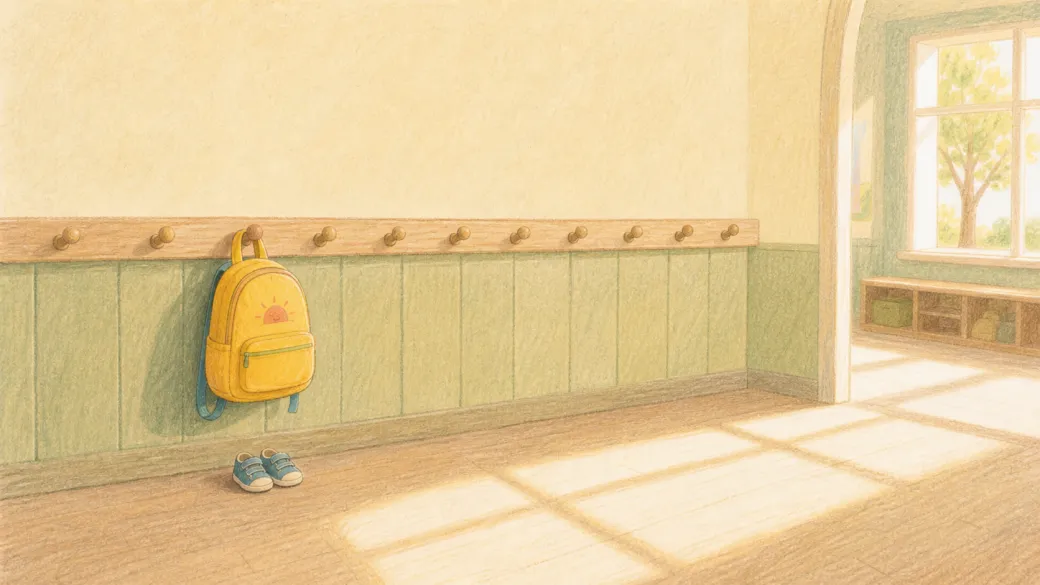
- Somebody who cannot find the right peg and tries three wrong ones first.
- Somebody who needs the toilet and does not know whether they are allowed to ask.
- Somebody whose lunchbox will not open.
- Somebody who does not know anyone's name and has to start with one.
- Somebody who goes through the wrong door and comes out somewhere unexpected.
- Somebody who finishes their work first and does not know what to do next.
- Somebody who wants to join a game that has already started.
- Somebody who forgets what their teacher is called, on the second day.
- Somebody who cries in the morning and is fine by the afternoon.
- Somebody who is asked a question in front of everybody and does not know the answer.
- Somebody who loses a jumper and gets it back from a box full of jumpers.
- Somebody who has a very good day and cannot explain any of it at pick-up.
That last one is worth telling. Children are routinely unable to report a day they enjoyed, and it helps for that to be normal rather than evidence something went wrong.
Show not-knowing, then finding out

The useful character does not begin confident. They do not know something, they do something ordinary about it — ask, wait, follow somebody — and then they know.
What is being modelled is the recovery, not the confidence. A character who was never worried has nothing to teach a child who is.
Related stories that already exist:
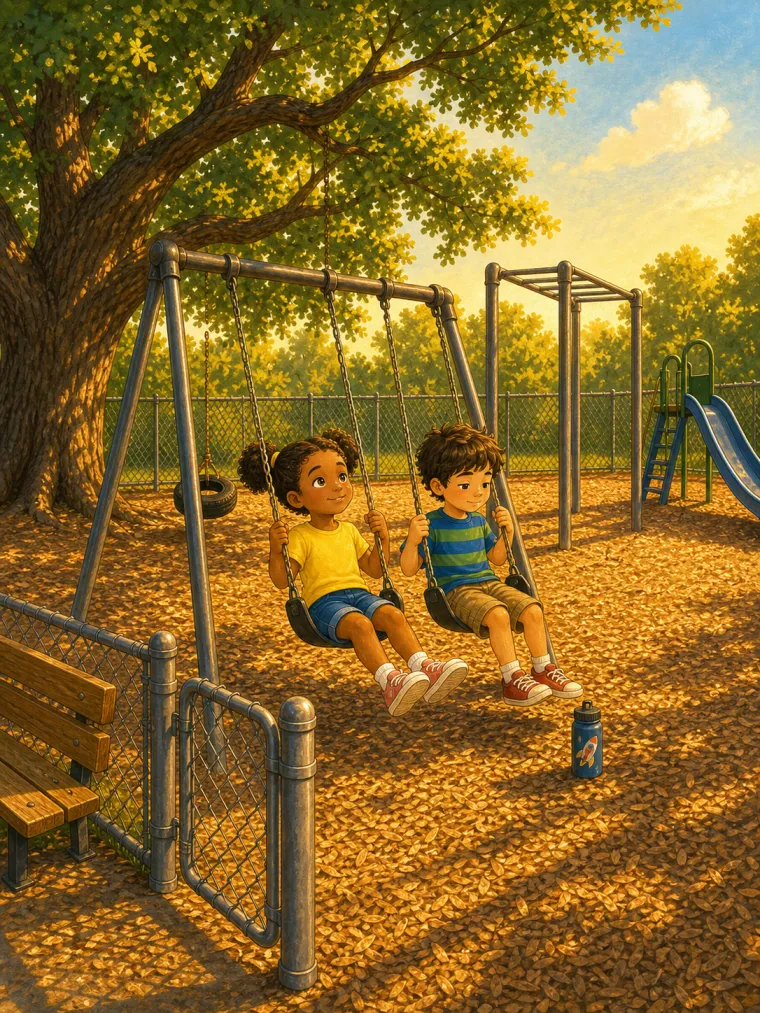
- A new kid at the gate and a swing built for two
- Naming what you feel when it is still too big
- A classroom where nobody looks quite the same
Read it early
The same story does two different things depending on when it arrives.
Read three weeks out, it is information — turned over slowly, returned to, asked about on a Tuesday for no obvious reason. Read on the final evening, it announces that tomorrow is significant enough to require preparation, which tends to produce the very thing it was meant to prevent.
Let something go wrong
A story in which everything goes smoothly makes a quiet promise that everything will. It will not — there will be a wrong peg or a forgotten name — and a child who has never seen that happen in a story has to meet it first in real life.
So let something small go wrong and be survivable. The surprising part has then already happened somewhere safe.
Making it about their school
The detail is what converts a general story into a rehearsal. The actual colour of the door, the actual walk, the actual name of the teacher, their own name in it.
That is the part no published book can do, and it is usually the reason a parent ends up making one.
Where ReadKidz fits
- Published school stories are about a school that is not the one your child is going to A story made in ReadKidz can carry the real details — the actual walk, the actual classroom door, the child's own name — which is the part an off-the-shelf book cannot supply. Is it worth using our actual school in the story?
Questions parents ask
When should we start reading about school?
Two to three weeks before is a reasonable window. Early enough that it is just information rather than an announcement, and long enough for questions to surface in their own time — which they usually do a few days in, not immediately.
My child says they are not worried. Should I leave it?
Mostly yes, on the direct route. A child who says they are fine will often still engage with a story where a character is not fine, and that is the more informative conversation anyway — it lets them raise something without having to claim it.
What if they ask a question I cannot answer?
Say so, and find out together. "I don't know where the toilets are — let's ask on the visit day" is more reassuring than a confident guess, partly because it demonstrates that not knowing is a manageable state.
Should the story be about a child or an animal?
Animals give more distance, which helps when the worry is sharp; a child character gives more recognition, which helps when the worry is vague. If your child is visibly anxious, the extra distance is usually worth having.
Is it worth using our actual school in the story?
Real details help a great deal — the colour of the door, the name of the teacher, the walk there. Specificity is what turns a general story about school into a rehearsal of this particular one.