


Talking to Young Children About Big Feelings
This is a practical guide to helping a 3-to-7-year-old name what they feel — why stories work better than explanations, and how to pick or make one that fits the feeling you are actually dealing with.
Key points
-
Why explanations do not land
A child in the middle of a big feeling has no spare capacity to learn a new word for it.
-
Why a story gets through
A story lets a child look at a feeling from the outside, which is the only safe angle when the feeling is still too big.
-
Match the situation, not the emotion category
"A book about feelings" is usually too general to help with the specific thing that happened.
-
Read it before you need it
The book works best when it is already familiar by the time the hard moment arrives.
-
Let them retell it wrong
A child changing the ending is not misunderstanding the story — it is them using it.
The moment the words disappear
Something happens at the party, or at bedtime, or in the car. The feeling is clearly enormous. You ask what is wrong, and you get either nothing or a version of the story that cannot be right. It is tempting to read this as a communication problem — as if the feeling is in there fully formed and your child is simply refusing to hand it over.
It usually is not. For most children between roughly three and seven, the feeling arrives long before the word for it does, and the gap between the two is not a matter of vocabulary. It is a matter of access.
Why the direct route fails

The part of the brain that notices a feeling, labels it, and decides what to do about it is among the last to mature — and among the first to drop out under stress. So the moment you most want your child to explain themselves is the moment they are least equipped to. "Use your words" is a reasonable request aimed at the wrong minute.
This has a practical consequence that is easy to miss: emotional vocabulary is taught during calm, and used during difficulty. Reversing that order looks like teaching and functions like pressure.
What a story does instead

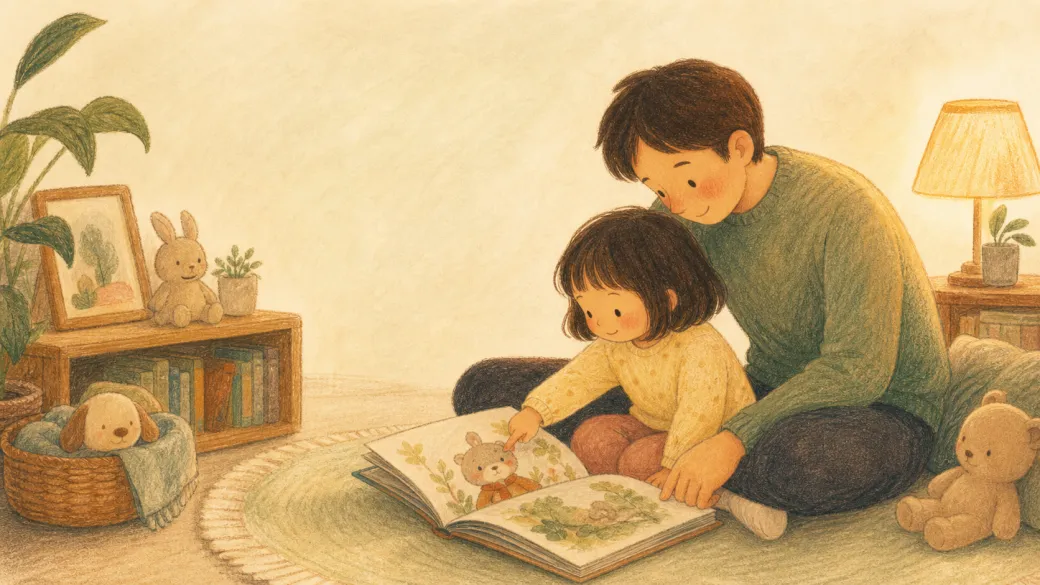
A picture book moves the feeling out of your child and into someone else. A bear is the one who feels too small. A cat is the one who cannot sleep. Your child gets to watch the feeling from the outside — close enough to recognise, far enough to stay curious.
That distance is the whole mechanism. It is also why a book that lands often gets requested every night for two weeks and then quietly retired. The repetition is the work.
Choosing the right story
The most common mistake is reaching for a book about emotions in general when the situation is specific.
A child who has just acquired a baby sibling does not need a survey of the emotional landscape. They need a story about someone who used to be the only one. Before you go looking, say the situation out loud in a single sentence — *she thinks we love the baby more*, *he is scared of the new house at night* — and then look for a story shaped like that sentence.
A few starting points from our own library:
- A story about naming what you feel
- A story about a new friend and a shared swing
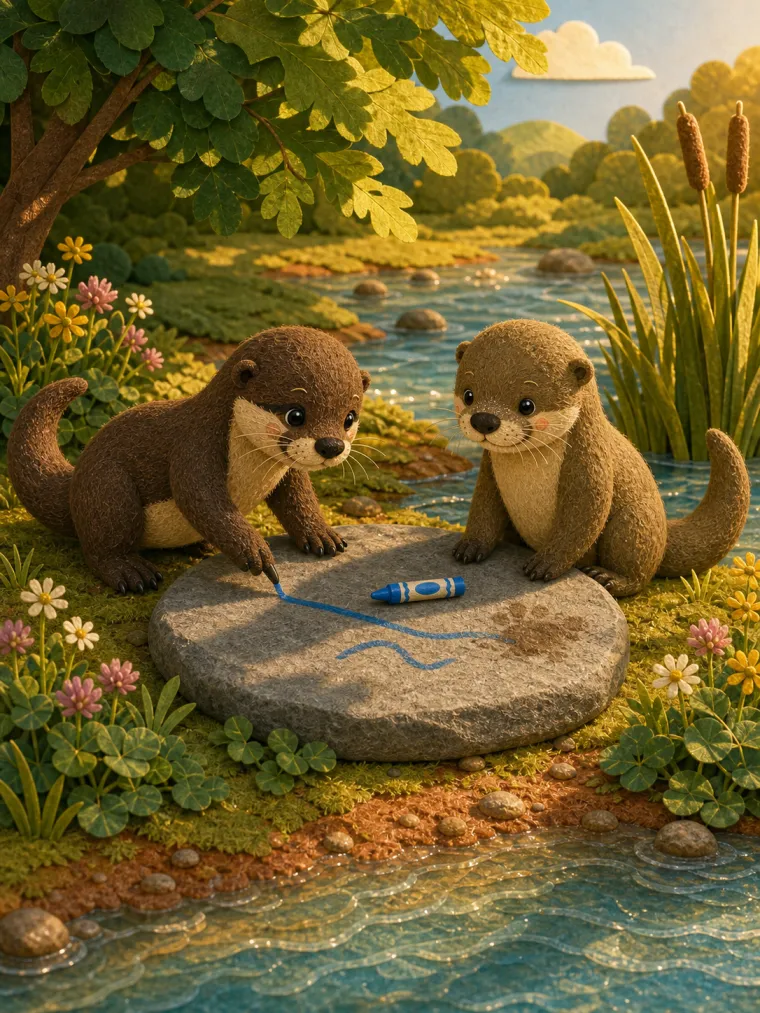
- A story about one crayon and two otters
- A story about the smallest umbrella on the street
- A story about a family that does not look like the one next door
Reading it at the right time
A story introduced in the middle of a hard moment reads as a lecture with pictures. The same story read three times the previous week, on ordinary evenings, becomes something else — a shared reference you can point at later, quietly, without making it a lesson.
So front-load the reading. Save the naming for afterwards, in the car or at bath time, in the past tense: *that was like the part where he felt like the smallest one, wasn't it.*
When they change the story
Sooner or later your child will retell the book wrong. The bear was angry, not sad. The ending was different. They will say this with total confidence.
Let it stand. A child rewriting a story is a child using it, and the version they need is not always the version that was published. If they want a different ending badly enough to argue about it, that is worth following — it usually points straight at the part of the situation that is still open.
And if the story your child needs does not exist yet, that is not unusual. Most family situations are too specific for the shelf. Describing it in a sentence and making the book yourself is often faster than looking for it, and the result has their name in it.
Where ReadKidz fits
- The specific situation a family is dealing with has no book written about it When no published book fits the exact situation, ReadKidz lets a parent describe it in a sentence and get back a complete illustrated story with their child's own details in it. Match the situation, not the emotion category
- A child rejects the ending of the story they were given If a child wants a different ending, the story can be regenerated with their version rather than argued with. Let them retell it wrong
Questions parents ask
At what age can a child name their own feelings?
Most children begin using feeling words around age 3, but using a word and recognising the feeling in themselves in real time are different skills — the second usually arrives years later and keeps developing through primary school. Expect naming to work in hindsight long before it works in the moment.
Should I read a book about a feeling while my child is upset?
Usually not. Reading during distress asks a child to take in new information when they have the least capacity for it, and it can read as a correction. Wait for calm, or better, read it in advance so it is already familiar when the hard moment arrives.
My child wants the same book every night. Is that a problem?
No — repetition is normally a sign the book is doing something. Children return to a story while they are still working on what it holds, and they usually stop asking for it once they are done. Let them lead on when to move on.
What if I cannot find a book about our specific situation?
Very specific situations — a particular family shape, a particular loss, a particular fear — are often not covered by published picture books, which is the most common reason parents end up making one. A story with your child's own situation and their own name in it does something an off-the-shelf book cannot.
Is it better to use a character my child already loves?
A familiar character lowers the barrier to starting, but it can also carry expectations about how that character behaves. For a feeling that is genuinely difficult, a new character your child has no history with often gives more room.